Buying Guide
How to source wholesale electronics for business use
By Cusket Editorial · Published · Updated
Source wholesale electronics by confirming specifications, certifications, accessories, packaging, MOQ, price tiers, delivery assumptions, and support before comparing supplier prices.
# How to source wholesale electronics for business use
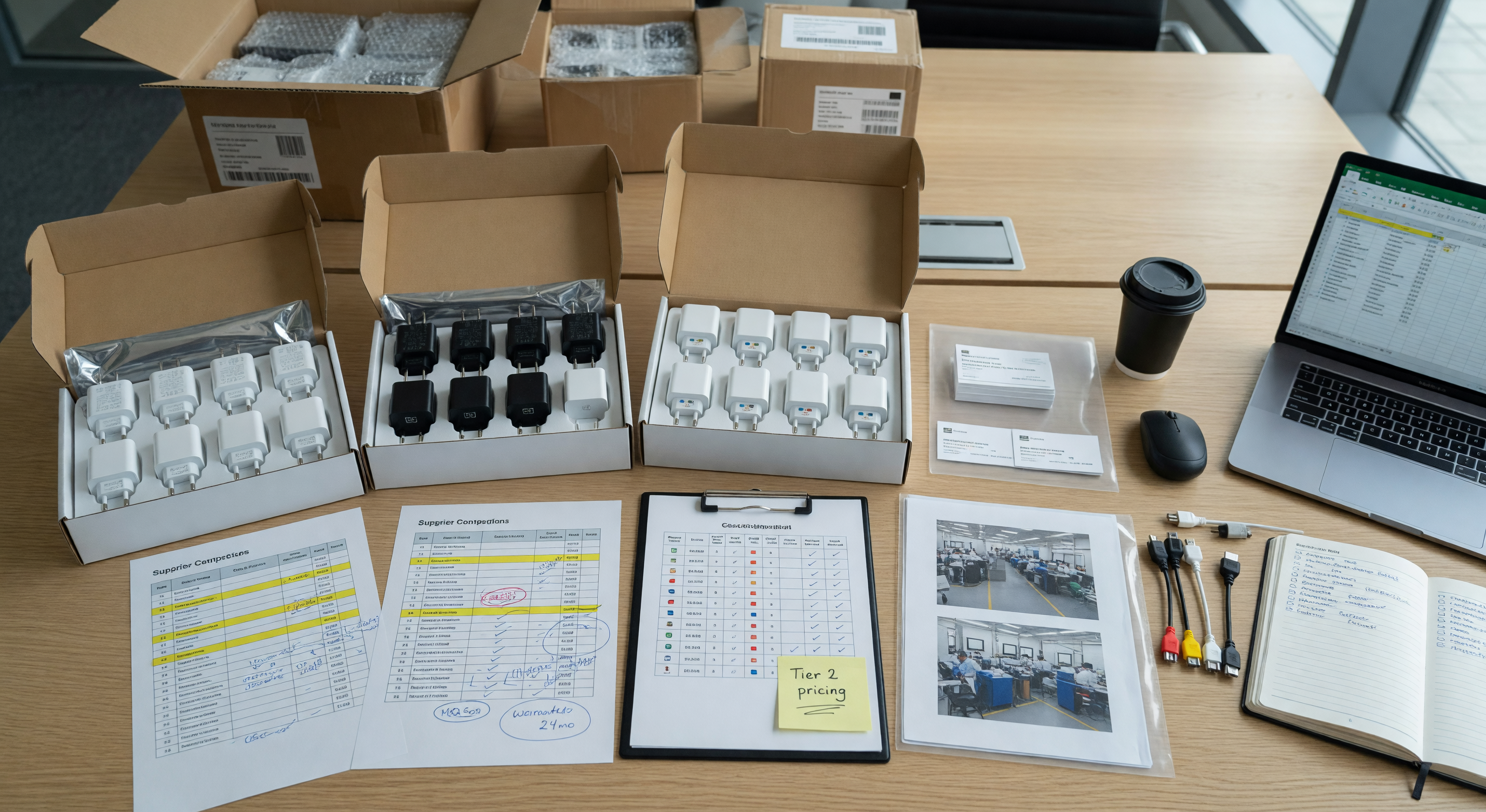
Wholesale electronics sourcing should start with a narrow definition of the item you actually need, not with a marketplace-wide search for the lowest price. For business buyers replacing retail purchasing with repeatable B2B sourcing, the goal is to compare suppliers on the same operating assumptions: specification, quantity, price tier, delivery responsibility, and support. Electronics look easy to compare until small differences in chipset, plug type, certification, firmware, packaging, warranty, and lead time change the real landed cost. Use this guide to turn a broad search into a shortlist that can survive a real purchase review.
Start on Cusket with buying guides, then move into Electronics and Electrical when there is a relevant category path, product discovery, and search results. For broader marketplace selection, compare this checklist with Cusket buying guides, Cusket vs Alibaba for B2B buyers, Amazon Business alternatives for small business procurement, and where to source products with clear delivery terms. The useful habit is to keep your sourcing notes next to the live listing so a low headline price does not overwrite the practical buying details.
Define the buying job before comparing suppliers
Write down the buying job in one paragraph before opening many tabs. Include who will use the product, the first order quantity, the expected reorder pattern, any must-have options, and the latest acceptable delivery date. For wholesale electronics, the first comparison fields should be model number and revision, input/output rating, certification scope, packaging format, warranty and failure handling. If those fields are unclear, the supplier is not ready for a clean price comparison yet.
A simple buying brief can be short:
| Field | What to record | Why it matters |
|---|---|---|
| Use case | Department, customer, machine, trip, package, workplace, or resale channel | Prevents comparing products that solve different problems |
| Required spec | Model, material, size, rating, format, coverage, or documentation | Keeps quotes aligned across suppliers |
| Quantity | Sample, pilot, first order, and likely reorder volume | Reveals whether MOQ and price tiers fit your cash flow |
| Delivery need | Latest acceptable date, handoff point, and tracking expectation | Separates product price from fulfillment risk |
| Support need | Who answers defects, activation issues, fit problems, or missing documents | Shows whether the supplier can support business use |
This brief should be shared with every shortlisted seller. If one supplier answers against a clear brief and another gives only a generic response, the first supplier is often easier to work with even when its first unit price is higher.
Supplier comparison table
Use this table as the minimum supplier scorecard. Add category-specific fields when the product is regulated, customized, technically complex, or time-sensitive.
| Area | Strong supplier evidence | Red flag |
|---|---|---|
| Spec clarity | Exact model, photos, datasheet, included accessories | Vague compatible-with descriptions without revision control |
| MOQ and tiers | Clear quantity breaks and mixed-SKU rules | A low unit price that only applies to an unusable volume |
| Compliance | Relevant safety, radio, battery, or power documentation | Certificates that do not match the listed product |
| Support | Defined defect window and replacement process | Seller only says factory warranty applies |
Do not score the supplier only on whether the answer sounds confident. Score whether the answer can be checked later. A useful response includes exact terms, documents, photos, links, samples, or written assumptions. A weak response depends on trust, speed, or a price that disappears once details are confirmed.
How to compare price, MOQ, and tiers
B2B listings often show more than one price. The right comparison is the price at your actual order quantity, with your required options, under the delivery term you can accept. If you are buying a pilot order, compare the pilot cost and the realistic reorder cost. If you are buying for immediate business use, compare the cost of delay and replacement as well as the unit price.
Build a small price model before accepting a quote:
| Cost line | Supplier A | Supplier B | Notes to confirm |
|---|---|---|---|
| Unit price at target quantity | Use the same quantity for every supplier | ||
| MOQ or minimum spend | Confirm whether variants can be mixed | ||
| Setup, sample, activation, proofing, or tooling | Separate one-time from repeat costs | ||
| Packaging, labeling, accessories, or documentation | Check what is included in the listed product | ||
| Delivery, insurance, duties, or handling | Tie this to the delivery terms, not a vague shipping promise | ||
| Defect, replacement, or support cost | Estimate the cost of supplier failure |
When a seller gives a very low tier price, ask which quantity, options, and delivery assumptions produce that number. A high-volume price is useful for future planning, but it should not be used to justify a first order unless you are actually buying that volume.
RFQ questions to send before ordering
Copy these questions into your RFQ, then add any category-specific requirement from your internal team. The goal is not to make the supplier write a long essay. The goal is to make hidden assumptions visible before payment.
- Which exact model and revision will ship for this quote?
- Can you provide datasheets, compliance documents, and packaging photos before payment?
- Are accessories, cables, adapters, batteries, manuals, or activation steps included?
- What is the price at 50, 100, 500, and 1,000 units, and can SKUs be mixed?
- How are DOA units, firmware mismatch, or missing accessories handled?
Ask for answers in writing and keep them with the order record. If the order later has a specification dispute, delivery issue, activation failure, wrong-size problem, or missing-document claim, the written answer is what helps separate buyer misunderstanding from supplier nonperformance.
Delivery terms and fulfillment checks
Delivery terms are part of the product offer. Before you buy, confirm who is responsible for packing, dispatch, export or domestic documents, freight booking, tracking, insurance, duties, taxes, final-mile delivery, and claims. For digital products, translate delivery terms into electronic fulfillment: what will be delivered, when it is considered delivered, how access is activated, and how invalid delivery is corrected.
Use this checklist before approving the order:
- Production lead time and transit time are shown separately.
- The quote states whether delivery cost is included or charged later.
- Tracking, delivery evidence, or electronic fulfillment evidence is defined.
- The seller explains what happens after delay, loss, damage, wrong address, failed activation, or missing item.
- The order page, quote, invoice, and messages all describe the same delivery assumption.
If the supplier says shipping is included, ask included to where and under which responsibility model. If the supplier says instant delivery, ask when the buyer's support window begins and what evidence proves successful delivery.
Red flags to pause on
- The supplier changes photos or model names during negotiation.
- Compliance documents show a different manufacturer, voltage, or product family.
- The quote excludes cables, plugs, labels, batteries, or packaging that the product page implies are included.
- Delivery terms are described only as fast shipping without responsibility, tracking, or handoff detail.
One red flag does not always disqualify a supplier, but it should slow the order down until the issue is answered. The most dangerous pattern is a supplier who is friendly, fast, and cheap while refusing to put operational details in writing.
Shortlist workflow on Cusket
A practical Cusket workflow is to read the relevant guide, open category or search pages, save comparable products, and turn the best listings into a structured RFQ. Start with /guides, /guides/cusket-vs-alibaba-b2b-buyers, /guides/where-to-source-products-with-clear-delivery-terms, /products, /search?q=electronics, /categories/ELECTRONICS_ELECTRICAL. For every candidate, record the same fields: listing URL, seller name, spec match, MOQ, price at your quantity, delivery terms, support promise, and unresolved questions.
Create a shortlist of three suppliers when possible. One should be the best price that still meets the brief. One should be the lowest-risk supplier with the clearest documentation. One should be a backup if lead time, stock, or support becomes a problem. This prevents the buying decision from becoming a choice between one attractive listing and no alternative.
Final buying checklist
Before checkout or quote approval, confirm these points:
- The product specification matches the business use case.
- MOQ and price tiers fit both the first order and likely reorder.
- Customization, setup, activation, accessories, packaging, or documentation costs are included or separately priced.
- Delivery terms identify responsibility, timing, evidence, and claim handling.
- The seller has answered support questions in writing.
- Someone on your team owns receiving, inspection, activation, or acceptance.
- The reorder path is clear enough that a successful first purchase can be repeated.
Good sourcing does not remove every risk. It makes the risk visible early enough to choose the right supplier, negotiate the right term, or walk away before the cost becomes real. Use this guide as a working checklist, then continue from Cusket guides into live search, category browsing, product pages, and supplier conversations with the same buying brief in hand.