Buying Guide
How to inspect labels and stickers quotes before ordering
By Cusket Editorial · Published · Updated
A buyer-focused checklist for reviewing labels and stickers quotes, including material, adhesive, print proof, roll direction, barcode readability, and approval details before ordering.
Start with the label use case, not only the unit price
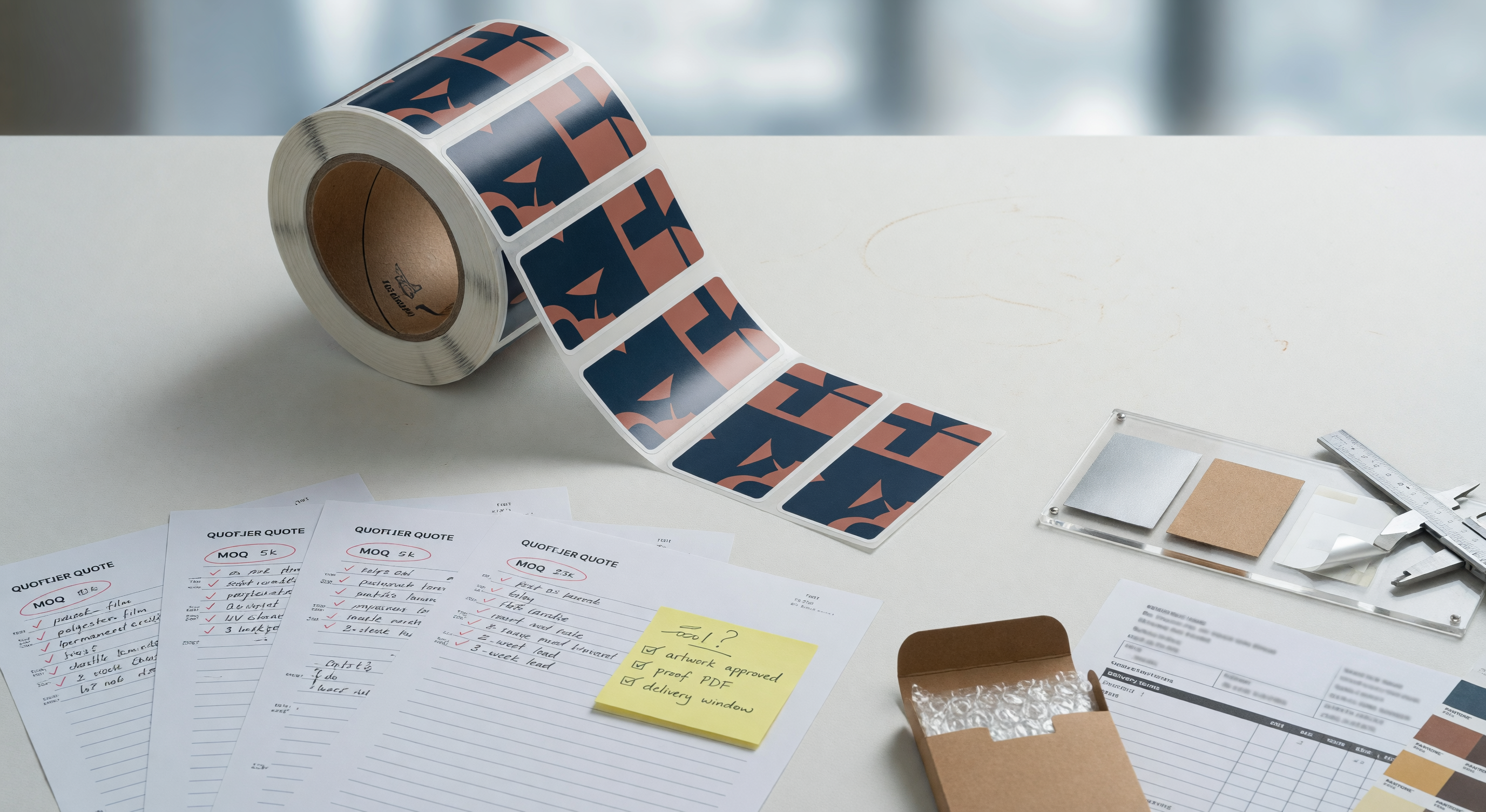
A labels or stickers quote can look simple: size, quantity, price, and delivery date. In practice, the same dimensions can describe very different products. A paper address label, waterproof bottle label, removable window sticker, barcode roll label, and laminated brand sticker all need different materials, adhesives, liners, print methods, and finishing assumptions.
Before you compare offers on Cusket products or continue searching through Cusket search, write down the job the label must perform. Note the application surface, expected handling, indoor or outdoor exposure, moisture, temperature range, and whether the label needs to stay permanent, peel away cleanly, or survive refrigeration.
Do not treat a quote as final unless it states the construction of the label: face material, adhesive type, liner, print method, finish, size tolerance, packing format, and proof process.
Check material, adhesive, and liner details
Material drives appearance, durability, and cost. Polypropylene, polyester, vinyl, or other films may be better when labels need water resistance, flexibility, outdoor durability, or a premium finish.
Adhesive matters just as much. Permanent adhesive is common for product labels, but removable adhesive may be needed for retail stickers, glass, temporary promotions, or reusable surfaces. Freezer-grade, high-tack, low-tack, repositionable, and wash-off adhesives each solve different problems.
The liner is also part of the product. Roll labels often use glassine, kraft, or film liners, and the liner affects dispensing, waste, machine compatibility, and manual peeling. For applicators, confirm roll core size, outside roll diameter, label gap, liner width, and unwind direction.
Compare print method, color proof, and finish
Print method changes color consistency, detail, setup cost, and economics at different volumes. Digital printing can suit shorter runs, variable artwork, faster sampling, or multiple SKUs. Flexographic printing may be better for longer runs, spot colors, and repeat orders.
Do not approve a quote only from a low-resolution mockup. Ask what proof is included: digital PDF, soft color proof, printed sample, press proof, or pre-production sample. A digital proof can confirm layout, spelling, barcode placement, dieline, and safe margins, but it may not show exact color, gloss, opacity, or texture.
Finish and lamination should be named clearly. Matte, gloss, soft-touch, UV varnish, anti-scratch lamination, waterproof lamination, and uncoated finishes behave differently.
Use a quote inspection checklist before approval
Use this checklist when comparing offers from multiple suppliers or saving shortlists from Cusket categories. It is designed for buyer review, not legal or tax interpretation, and should be adapted to your product, market, and internal approval process.
| Quote item | What to verify | Why it matters |
|---|---|---|
| Face material | Paper, PP, PET, vinyl, clear film, or specialty stock; thickness if relevant | Controls durability, texture, opacity, and cost |
| Adhesive type | Permanent, removable, freezer, high-tack, low-tack, wash-off, or repositionable | Determines whether the label bonds correctly to the surface |
| Liner and format | Roll, sheet, core size, roll diameter, gap, liner width, kiss cut | Affects peeling, application speed, and applicator compatibility |
| Size tolerance | Finished size, die-cut tolerance, gap tolerance, bleed, safe margin | Prevents artwork, trim, or machine-feeding surprises |
| Print and color proof | Digital, printed sample, press proof, Pantone or CMYK handling | Reduces color, barcode, and layout risk before production |
| Finish or lamination | Matte, gloss, UV, soft-touch, anti-scratch, waterproof, none | Protects the printed surface and changes visual feel |
| Roll direction | Inside or outside wound, unwind position, leading edge | Critical for automatic label applicators |
| Barcode readability | Quiet zone, contrast, size, verification method if required | Helps avoid scanning issues in receiving, checkout, or inventory |
Confirm tolerances, roll direction, and barcode readability
Labels are small, so small tolerances are visible. Ask for finished size tolerance, die-cut tolerance, print-to-cut registration tolerance, and whether the supplier needs bleed or safe zones around text and logos. If your artwork has a border, fine line, small QR code, or edge-to-edge color, tolerance becomes more important.
Roll direction is easy to overlook until labels reach a filling line or application tool. For machine-applied labels, confirm whether the label is wound face-in or face-out, which edge leads off the roll, the gap between labels, and whether the sensor mark or liner opacity is compatible with the applicator. A quote that omits roll direction may still be usable for hand application, but it can create downtime for automated application.
For barcodes, QR codes, batch labels, and serial labels, check readability before approving mass production. Confirm the final printed size, contrast, quiet zone, placement, and whether lamination or a glossy finish might create scanner glare. If barcode performance is operationally important, request a printed sample or supplier verification method instead of relying only on the artwork file.
Review exposure, samples, and ordering next steps
Application conditions should be part of quote review. A label applied to a cold wet bottle has different requirements from a dry carton label. A sticker used outdoors may need UV-resistant inks and weather-resistant film. A freezer product may need freezer-grade adhesive and a process for applying labels at the right temperature. Bath, cosmetic, food, chemical, or logistics labels may also have industry-specific requirements, but buyers should verify those obligations with qualified advisers instead of treating any marketplace quote as compliance advice.
Before placing a larger order through Cusket buy, ask whether a sample proof or pre-production sample is included, paid, refundable, or credited to the order. Approve the sample against the real surface when possible. Check edge lift, wrinkle behavior, color, opacity, scuff resistance, barcode scan, peel feel, and packaging format. If there are multiple SKUs, approve each artwork version or confirm which changes are covered by the same proof.
Keep your final approved quote with the artwork version, dieline, material, adhesive, liner, print method, finish, tolerance, quantity, lead time, packing format, and shipping assumptions. If anything is unclear, contact the seller before payment or use Cusket support for platform questions. For more sourcing guidance and buyer checklists, continue through Cusket guides before you commit to repeat production.