Buying Guide
Power adapter MOQ guide
By Cusket Editorial · Published · Updated
A product-level guide for understanding power adapter MOQ, certification requirements, plug variants, packaging, price tiers, and supplier quote assumptions.
Start with voltage, current, plug, and certification
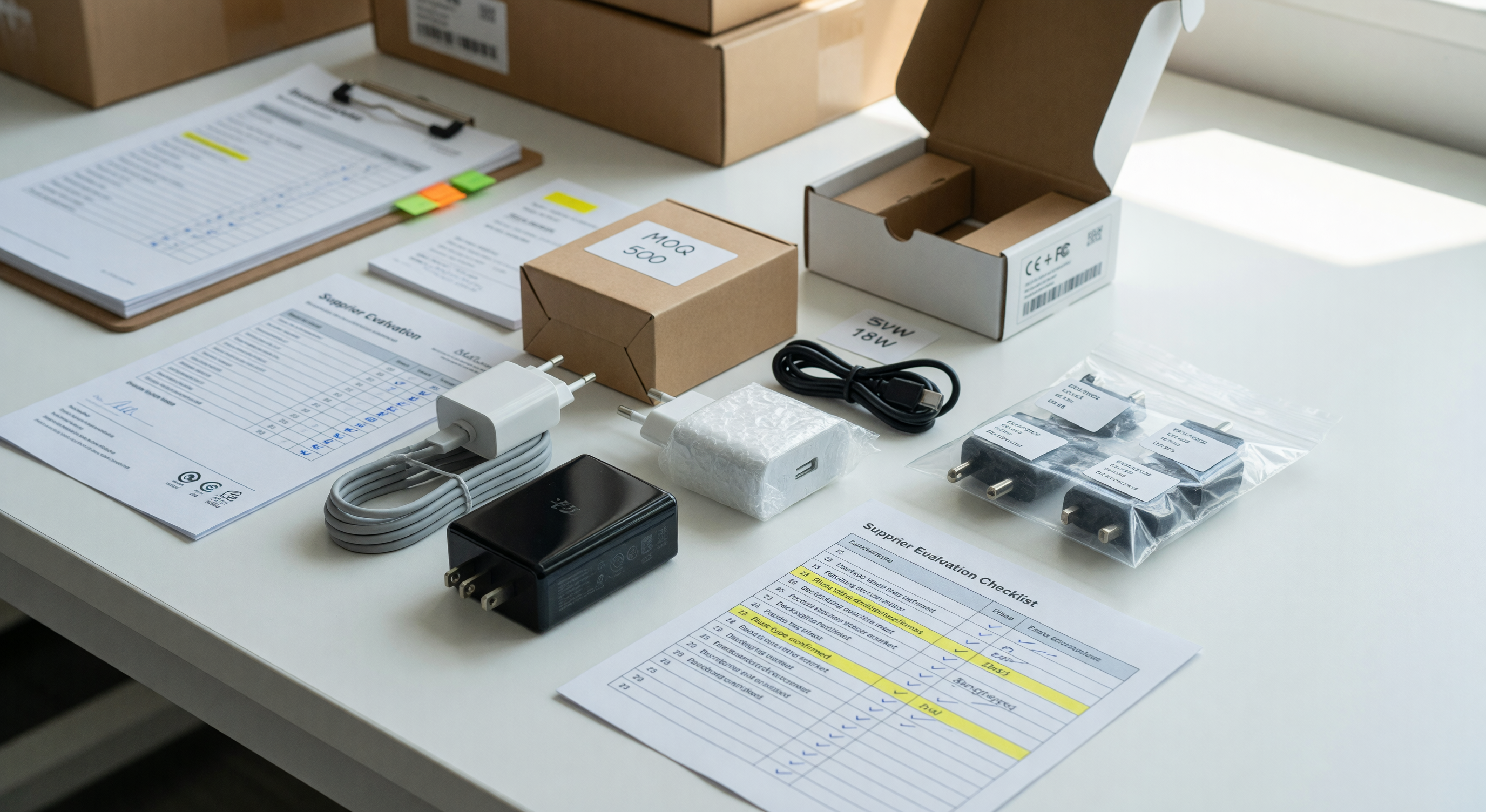
Power adapter sourcing should begin with the electrical requirement, plug type, region, safety approvals, labeling, packaging, and intended device. MOQ and price only make sense after the buyer knows whether each supplier is quoting the same adapter class and compliance path.
Define the adapter before asking for price
Write the adapter requirement as an electrical and market specification, not a product nickname. Include input voltage range, output voltage, output current, total wattage, connector type, cable length if fixed, USB-C PD profile if applicable, ripple/noise expectations, efficiency level, standby power, operating temperature, housing color, plug type, and intended destination country. If the adapter is bundled with a device, include the device load, charging behavior, retail channel, and warranty expectation.
Certification is the biggest reason adapter quotes vary. Ask whether the quote includes UL, ETL, FCC, CE, UKCA, CB, PSE, KC, RCM, BIS, DOE Level VI, or other marks relevant to your sales market. The important question is not whether the factory has a certificate somewhere; it is whether the exact model, enclosure, circuit, plug, label, and output profile you are buying are covered. A supplier may offer a lower MOQ for an existing certified model and a much higher MOQ or tooling fee for a new housing, private label, or unusual output.
MOQ and price tiers
Price tiers should be read as a model, not a promise. A supplier may show one unit price at sample quantity, another at carton quantity, and a lower number at pallet or container quantity. Your landed cost should include setup charges, tooling, artwork, testing, labeling, export packing, freight, duties, payment fees, and the cost of quality failures. The lowest unit price is rarely the lowest total purchase cost if it forces the wrong MOQ, hides a long lead time, or excludes required documentation. For power adapters, MOQ often splits into four layers: existing model with standard label, existing model with private label, modified model with new plug or cable, and new design requiring tooling or certification updates. A supplier might accept 100 or 300 units for a standard adapter, 500 or 1,000 units for label customization, and several thousand units when new tooling or certification paperwork is needed.
Ask whether MOQ is per plug type, per label language, per certification mark, per packaging version, or per shipment. If you need US, EU, UK, and AU variants, the total purchase quantity may look large while each plug version remains below the economic MOQ. You can sometimes reduce risk by starting with an approved standard model, plain carton packaging, and a smaller first order, then moving to custom packaging when defect rate and demand are proven.
Sample, test, and approval path
For custom or compliance-sensitive items, do not skip the proof path. Ask for a pre-production sample, golden sample, digital proof, material certificate, test report, or dimensional drawing before mass production. Store the approved proof with the quote so receiving, support, and reorder teams know what was actually accepted. With adapters, a visual sample is not enough. Test output stability under load, thermal rise, plug fit, USB-C negotiation, enclosure finish, cable retention, label durability, barcode scan, and packaging drop resistance. For private-label orders, approve both the physical sample and the rating label artwork because an incorrect label can create compliance and customs problems even when the electronics work.
Request a document pack before mass production: datasheet, declaration of conformity where applicable, test report, certificate copy, bill of materials sensitivity statement, label artwork, packaging dieline, and carton mark. For higher-risk purchases, add incoming inspection criteria and agree what happens if the factory changes chipset, transformer, capacitor brand, enclosure material, or cable supplier.
RFQ questions to ask
- Is the quoted adapter an existing certified model or a modified/custom model?
- Which exact safety and EMC approvals apply to the destination market?
- Is MOQ calculated per plug, wattage, label language, package, or total order?
- Are private label, retail box, manual, barcode, and master carton marks included?
- What is the sample fee, and is it refundable against a mass order?
- What components may be substituted without written approval?
- What burn-in, load, hi-pot, and visual inspections are performed?
- Which delivery term is quoted, and who handles batteries or device-bundle restrictions if relevant?
Red flags
Red flags include vague product names, copied specification sheets, missing certification numbers, resistance to samples, unclear ownership of tooling, price breaks that change after questions, no written lead time, and quotes that omit packaging or delivery responsibility. A good supplier may still need clarification, but they should be able to document what they will make, when they will make it, and what is included in the price. For power adapters, specific red flags include certification files that do not match the model number, no answer on plug-market compliance, price tiers that ignore private-label cost, and samples that run hot at the rated load. Be cautious when a supplier says the adapter is suitable worldwide but cannot explain plug variants, labeling, or local marks. Also treat very low prices for high-wattage USB-C PD units carefully, because missing components or weak thermal design may not show up in a product photo.
Next step in Cusket
Cusket is most useful for this kind of purchase when the buyer can move from a checklist into product discovery, seller comparison, RFQ, cart, or checkout without losing the commercial assumptions. Use the Cusket guide hub for broader sourcing context, then open product search or the relevant category page when you are ready to compare live listings. Use power adapter search to compare visible product claims, then read how to compare B2B price tiers and delivery terms before buying before accepting a supplier quote. If the order involves custom labeling or retail packaging, also review custom product supplier comparison.
Quote comparison fields to score
Compare adapters with a table that separates electrical rating, certified model number, plug type, output connector, enclosure, label language, packaging, MOQ, setup fees, sample lead time, mass lead time, inspection plan, and delivery term. Add a column for excluded costs because adapter quotes often leave out private-label artwork, certificate updates, retail packaging, or destination testing. If the adapter is bundled with another product, score whether the supplier can keep the adapter, cable, manual, and carton compliant as one finished kit.
Acceptance criteria before purchase
Set pass criteria before the first order: no overheating under expected load, correct USB-C or barrel-connector behavior, label matching the approved certificate, plug blades fitting the target market, package surviving transit, and documentation matching the shipment model. Also define a no-substitution rule for critical components unless the supplier requests written approval. That rule protects you from quiet changes after the sample looks good.