Buying Guide
How to build a buyer shortlist for a new B2B category
By Cusket Editorial · Published · Updated
A practical buyer checklist for turning a new B2B category into comparable supplier evidence, clearer finalist decisions, and fewer first-order surprises.
Start with the business reason for the category
A new B2B category usually begins with a gap: a replacement part is no longer available, a buyer needs a backup source, a team is expanding into a new product line, or an internal specification has become more demanding. Before collecting supplier names, write down the business reason in one or two sentences. That reason will help you separate suppliers that are merely visible from suppliers that are actually useful.
Define what success means for the first purchase. You may need the lowest landed cost, but in a new category the safer target is often a supplier that can explain options, confirm fit, and support a first order without forcing your team to absorb every unknown. Use Cusket discovery pages such as https://cusket.com/categories and https://cusket.com/products to understand how the category is structured.
Translate the need into comparable requirements
A shortlist works only when every supplier is measured against the same requirements. Start with the item itself: material, dimensions, voltage, capacity, certification, compatible model, packaging format, digital delivery needs. Then add order requirements: target quantity, expected reorder pattern, delivery country, preferred currency, documentation needs, and whether your team needs samples before a larger purchase.
Do not over-specify too early. If you are still learning the category, mark some fields as "must confirm" instead of treating guesses as hard requirements. Search results at https://cusket.com/search can help you see which product attributes suppliers commonly publish.
Build a broad first list, then narrow it deliberately
For a new category, begin wider than your final shortlist. A practical first pass is 12 to 20 possible products or suppliers. Include obvious matches, near matches that may support customization, and a few higher-priced options if they provide stronger proof. This prevents the shortlist from becoming a mirror of the first search results you happened to see.
As you review each option, capture evidence instead of impressions. Record the product URL, the supplier name, price or price condition, listed stock or lead time, minimum order quantity, delivery region, and any visible quality signals. If a product is missing key information but otherwise promising, keep it in the first list with a note to verify.
Score suppliers on proof, fit, and buying risk
Once you have a first list, score each candidate on the same dimensions. Keep the scoring simple enough that another teammate could understand it without a meeting. A five-point scale works well: 5 means strong evidence, 3 means acceptable but needs confirmation, and 1 means weak or unclear.
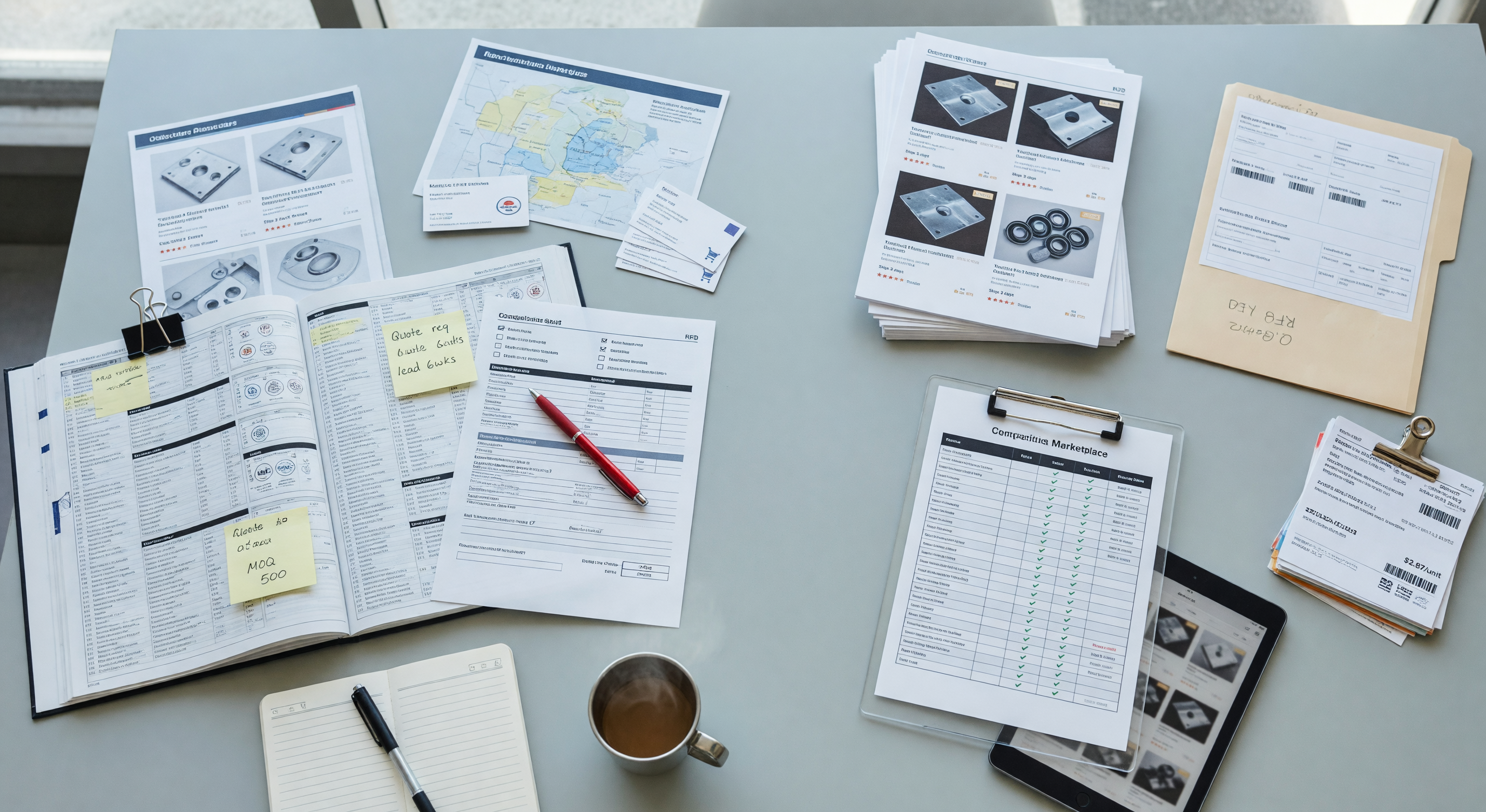
Use this checklist as a working shortlist table:
| Check | What to Look For | Why It Matters | Score |
|---|---|---|---|
| Product fit | Specifications, variants, compatibility, and category match | Prevents comparing products that solve different problems | 1-5 |
| Supplier evidence | Clear product details, company context, reviews, or order history | Shows whether the supplier can support a serious buyer | 1-5 |
| Commercial fit | Price condition, MOQ, sample path, currency, and payment flow | Keeps the option realistic for your budget and approval process | 1-5 |
| Delivery fit | Destination support, lead time, delivery terms, and required documents | Reduces surprise costs and timeline risk | 1-5 |
| Communication risk | Missing details, unclear options, slow replies, or inconsistent claims | Flags issues that can delay the first order | 1-5 |
| Expansion potential | Ability to support repeat orders, adjacent products, or higher volume | Helps the shortlist serve future demand, not only one purchase | 1-5 |
A supplier does not need a perfect score to stay on the shortlist. For a new category, the best candidates often have acceptable fit and clear next questions. Remove candidates when the risk is structural: incompatible specifications, unsupported delivery needs, unrealistic MOQ, or claims that cannot be verified.
Use product pages to confirm ordering details
Before you compare finalists, revisit the product pages and confirm the details that change the buying decision. Check whether the listing explains what is included, whether options are selectable, whether price is available, and whether the page gives enough delivery context to support an internal approval request. If your team plans to buy through Cusket, review the buyer flow at https://cusket.com/buy so the shortlist reflects the actual ordering path.
Pay special attention to category-specific risks. For industrial components, compatibility and certifications may matter more than small price differences. For consumables, reorder stability and packaging can be decisive. For digital goods, access method, license scope, and delivery timing may be the main risk. A good shortlist makes those risks visible.
Reduce the list to three to five defensible options
A buyer shortlist should be short enough to support action. Three to five options is usually enough for a new B2B category: one best-fit candidate, one cost-effective candidate, one lower-risk or better-documented candidate, and one or two backups if the category is fragmented. If your list still has ten suppliers, the evaluation criteria are probably too loose.
For each finalist, write a short decision note: why it stays, what still needs confirmation, and what would disqualify it. This is useful when the shortlist must be shared with finance, operations, engineering, or a manager who was not involved in the search. Keep the language concrete. "Best visible compatibility evidence" is more useful than "strong supplier."
Keep the shortlist reusable after the first order
The first order should improve the next buying cycle. After the purchase, update the shortlist with what actually happened: accepted payment method, final delivery time, packaging condition, document quality, support experience, and whether the product matched the listing. If a supplier performed well, keep the notes for reorder planning. If a supplier was not selected but looked credible, keep them as a backup.
You can also use https://cusket.com/guides for adjacent buying guidance as your category knowledge improves. If something in the buying path is unclear, contact https://cusket.com/support with the specific product URLs and decision notes. A shortlist built this way becomes more than a one-time comparison; it becomes a lightweight procurement asset that helps your team buy the new category with less guesswork each time.