Buying Guide
Custom labels quote checklist
By Cusket Editorial · Published · Updated
A product-level quote checklist for custom labels, including material, adhesive, finish, artwork, roll format, MOQ, proofing, and delivery expectations.
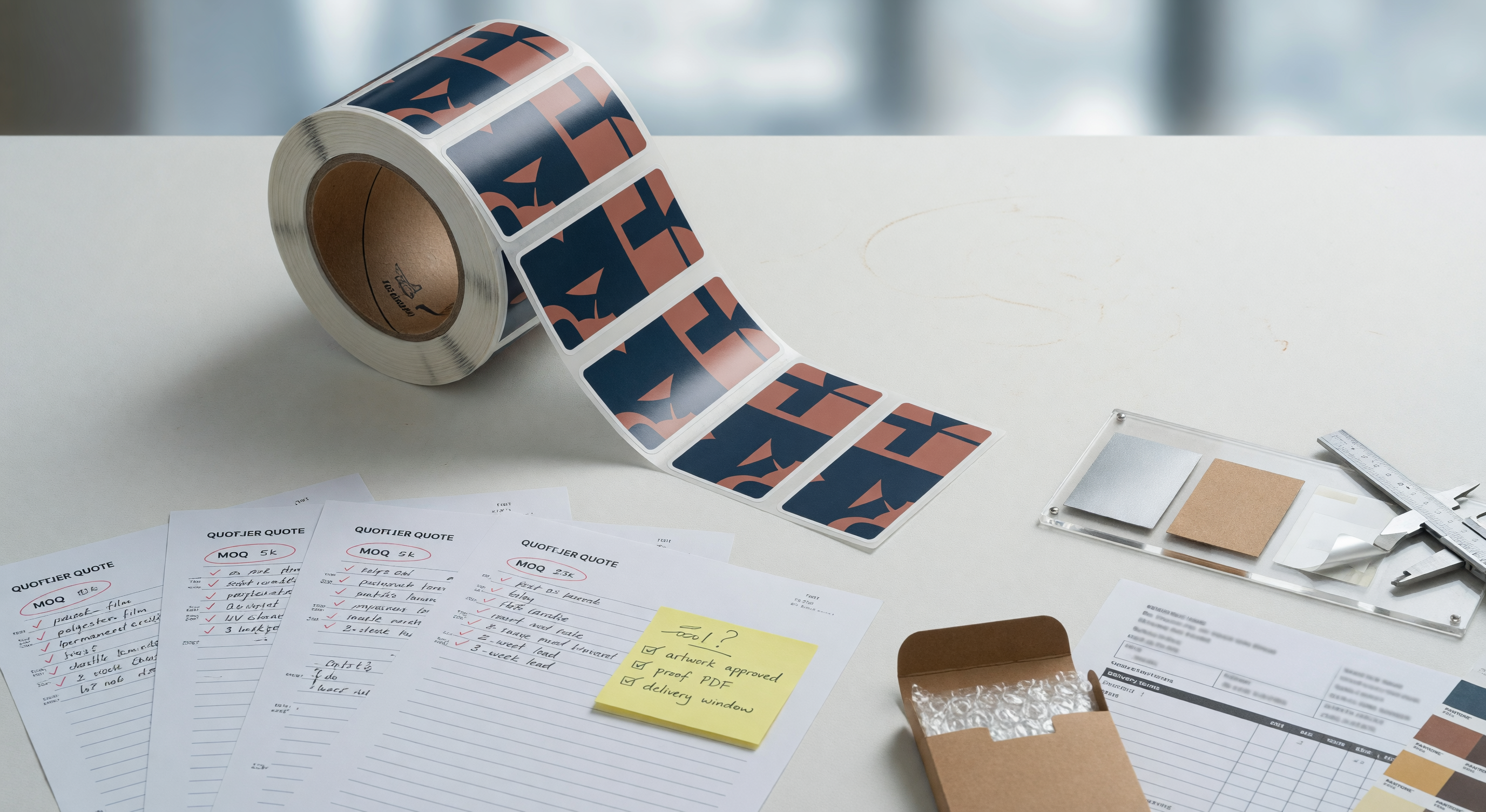
Start with label use, material, adhesive, and finish
Custom label quotes change quickly when surface material, adhesive, finish, roll direction, die shape, ink coverage, and environment are unclear. Buyers get better responses when the quote request explains how and where the label will be applied.
Product specs to define
Start with the application. A label for glass skincare bottles, frozen food pouches, warehouse cartons, outdoor equipment, candles, chemical bottles, or shipping cartons needs different material and adhesive choices. State surface material, surface shape, application temperature, service temperature, moisture exposure, oil exposure, abrasion risk, expected shelf life, and whether the label must be removable, permanent, tamper-evident, freezer-grade, direct-thermal, thermal-transfer, or waterproof.
Then define the physical label: width, height, shape, corner radius, gap, core size, roll outer diameter, unwind direction, labels per roll, sheet or roll format, and whether the label will be applied by hand or machine. Print details should include number of colors, CMYK or spot color, white ink, varnish, laminate, foil, embossing, variable data, sequential numbering, barcode, QR code, and regulatory text. If the label supports cosmetics, food, chemicals, or medical-adjacent products, ask the supplier what documentation they can provide for materials and inks.
MOQ and price tier logic
Price tiers should be read as a model, not a promise. A supplier may show one unit price at sample quantity, another at carton quantity, and a lower number at pallet or container quantity. Your landed cost should include setup charges, tooling, artwork, testing, labeling, export packing, freight, duties, payment fees, and the cost of quality failures. The lowest unit price is rarely the lowest total purchase cost if it forces the wrong MOQ, hides a long lead time, or excludes required documentation. Label MOQ often depends on material roll width, die shape, print setup, finishing, and artwork versions. A standard rectangle on common paper stock may have a low MOQ, while a custom die-cut waterproof film label with foil and multiple SKUs may require a higher run. Ask whether MOQ is per artwork, per size, per material, or total label count.
For multiple SKUs, request a matrix. You need to know whether 10,000 labels across five scents counts as one 10,000-label order or five 2,000-label orders. If the supplier uses digital printing, lower variant counts may be practical. If flexo plates or special dies are required, ask which costs are one-time and which repeat. Compare price per label against waste, roll changes, application downtime, and the cost of relabeling defective stock.
Sample and proofing path
For custom or compliance-sensitive items, do not skip the proof path. Ask for a pre-production sample, golden sample, digital proof, material certificate, test report, or dimensional drawing before mass production. Store the approved proof with the quote so receiving, support, and reorder teams know what was actually accepted. For labels, proofing must cover both artwork and application performance. Request a digital proof for text and barcode, a color proof when brand color matters, and physical samples on the intended container or packaging material. Test adhesion after the product is filled, cooled, heated, refrigerated, handled, wiped, or exposed to moisture. Scan barcodes under real lighting and confirm that small text remains readable after finish or laminate is applied.
If labels are machine-applied, run the sample roll through the applicator before approval. Confirm unwind direction, core size, roll tension, gap sensing, matrix waste removal, and liner strength. For regulated product labels, keep a reviewed artwork version and final supplier proof with the quote.
RFQ questions to ask
- What face stock, adhesive, liner, finish, and print method are included?
- Is the label designed for the actual surface, temperature, moisture, and handling conditions?
- Is MOQ per artwork, size, material, die, or total order?
- Are die, plate, proof, variable-data setup, and color-match fees separate?
- What roll direction, core size, labels per roll, and outer diameter are assumed?
- Can the supplier provide material samples and production proofs?
- Are barcode grade, QR readability, and small-text legibility checked?
- What lead time applies after artwork approval?
Red flags
Red flags include vague product names, copied specification sheets, missing certification numbers, resistance to samples, unclear ownership of tooling, price breaks that change after questions, no written lead time, and quotes that omit packaging or delivery responsibility. A good supplier may still need clarification, but they should be able to document what they will make, when they will make it, and what is included in the price. For labels, be cautious when a supplier says waterproof without naming the face stock and adhesive, quotes custom shapes without die cost, or ignores whether labels are hand-applied or machine-applied. A supplier who will not test the label on the actual container may be shifting application risk to you. Also watch for quotes that omit rewind direction, roll size, or finish, because those details can make good labels unusable in production.
Next step in Cusket
Cusket is most useful for this kind of purchase when the buyer can move from a checklist into product discovery, seller comparison, RFQ, cart, or checkout without losing the commercial assumptions. Use the Cusket guide hub for broader sourcing context, then open product search or the relevant category page when you are ready to compare live listings. Open custom label search and compare suppliers in the labels and stickers category. For related decisions, read how to compare suppliers for custom products, how to source packaging products, and how to compare B2B price tiers.
Quote comparison fields to score
Compare label quotes by face stock, adhesive, liner, finish, die shape, roll direction, core size, labels per roll, print method, color handling, barcode or variable-data support, MOQ per artwork, setup fees, proofing path, lead time, and delivery term. Add an application-risk column. Labels for curved bottles, oily surfaces, freezer cases, outdoor products, candles, or squeezable tubes need more evidence than labels for dry cartons.
Acceptance criteria before purchase
Set approval rules for artwork, color, text legibility, barcode scan, adhesive performance, roll direction, roll tension, finish, and package labeling. Apply sample labels to the real container and leave them through the expected temperature, moisture, handling, and storage cycle. If the label is machine-applied, the sample must run through the applicator. A cheap label that slows the line or peels after filling is not a cheap label.
Planning the first order
For a first custom label order, balance MOQ against artwork risk. If ingredients, warnings, barcode data, scent names, or package dimensions may still change, ask for a lower validation run or a supplier that can support digital printing. Keep enough labels for launch, sampling, and rejects, but do not overbuy before the label has passed application testing. Ask suppliers to quote the reorder tier at the same time so a successful launch does not create a surprise price jump.