Buying Guide
How to choose between low MOQ and better unit economics: scorecard
By Cusket Editorial · Published · Updated
Use a buyer-facing scorecard to decide when low MOQ protects cash and when stronger unit economics justify a larger order.
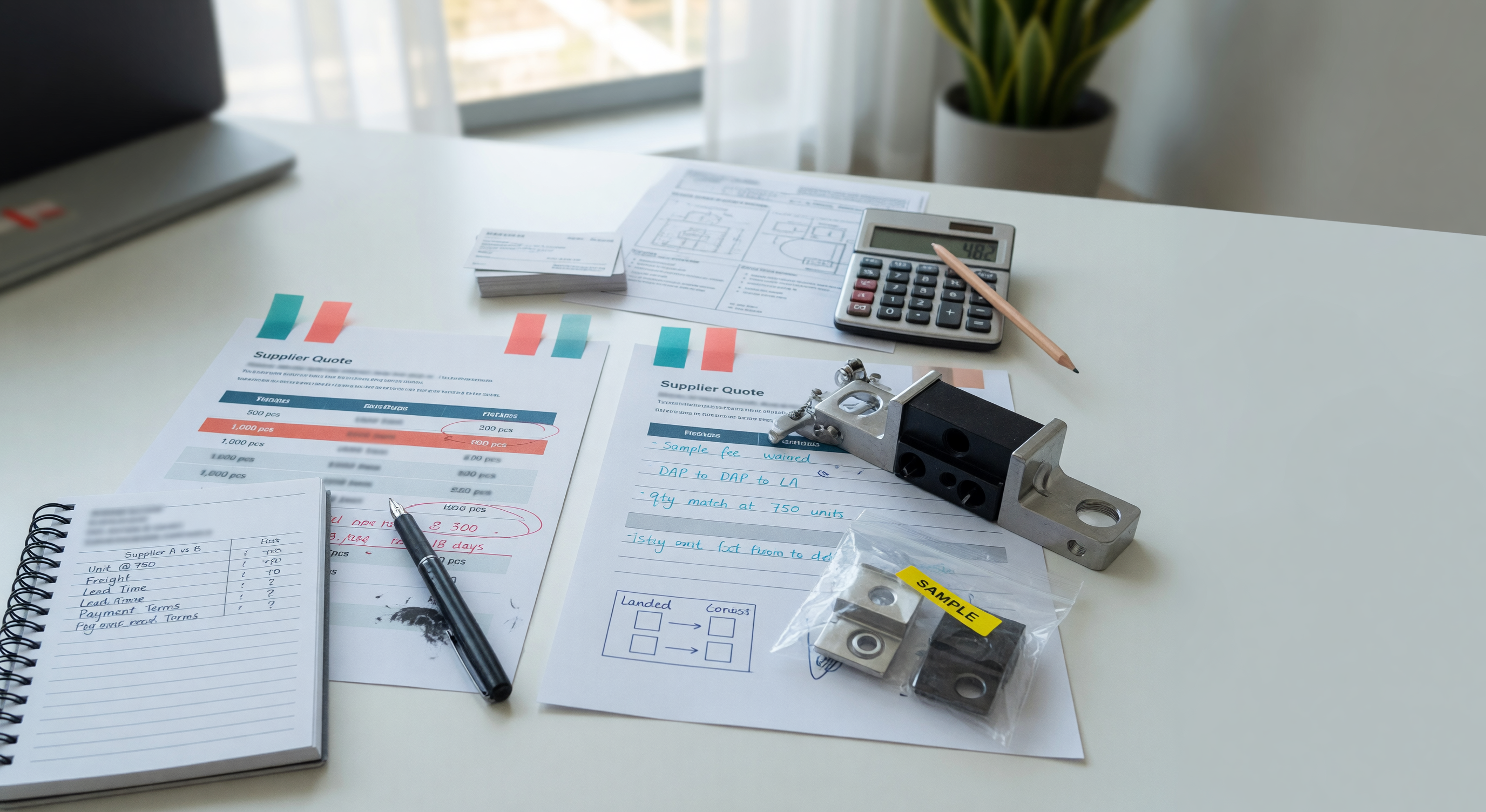
The decision is not MOQ versus price
A low minimum order quantity can look safer because it limits cash tied up in inventory. Better unit economics can look smarter because every unit costs less.
Use this guide as a scorecard, not as a rule that low MOQ is always cautious or bulk pricing is always efficient. Compare cash exposure, sell-through confidence, operational complexity, margin, and learning value before you commit. Start with live research on Cusket products, then use Cusket search and Cusket categories to compare similar listings across MOQ, price tiers, delivery terms, and checkout readiness.
Use the scorecard before you negotiate
Score the tradeoff before you ask for changes. If you negotiate MOQ first, you may ignore landed cost. If you negotiate unit price first, you may accept more inventory than the business can absorb. A scorecard keeps the conversation tied to the buying case.
Score each factor from 1 to 5. A score of 1 strongly favors a smaller test order. A score of 5 strongly favors a larger order with better unit economics. Use the notes column to capture evidence, not hopes.
Scorecard: low MOQ versus unit economics
| Factor | Score 1 favors low MOQ | Score 5 favors better unit economics | What to check |
|---|---|---|---|
| Demand confidence | New product, no reliable sales history | Repeat item with proven sell-through | Past sales, search volume, buyer commitments |
| Cash exposure | Budget is tight or needed elsewhere | Cash is available without delaying other buys | Order total, payment timing, holding period |
| Gross margin impact | Margin remains acceptable at small quantity | Price break materially improves margin | Unit price tiers, fees, packaging, freight |
| Inventory risk | Slow-moving or trend-sensitive product | Stable product with predictable replenishment | Seasonality, expiry risk, storage limits |
| Operational load | Team can only handle a small launch | Receiving, QA, labeling, and fulfillment are ready | Warehouse capacity, inspection time, returns process |
| Supplier learning value | You need to test quality and communication | Supplier is already trusted or well documented | Samples, reviews, response quality, issue history |
| Delivery timing | You need flexibility more than savings | Longer lead time is acceptable for savings | Production time, transit, delivery terms |
| Market positioning | Buyers may reject price even at low volume | Lower unit cost supports competitive pricing | Target retail price, competitor pricing, bundles |
Add the eight scores. A total near 8 to 18 usually points toward a low-MOQ test. A total near 30 to 40 usually points toward ordering for stronger unit economics. A middle score means the decision should come from the factor with the largest downside, not the average.
Read the cost signals behind each score
Unit price is only one part of unit economics. A larger order can reduce manufacturing cost but increase storage, insurance, working capital pressure, and markdown risk. A smaller order can protect cash but leave too little margin after fees, handling, packaging, and freight.
When comparing listings, record the actual quantity break, not just the lowest displayed price. A product may show an attractive price at a quantity your team cannot sell through. Another product may have a higher first tier but cleaner delivery terms, better documentation, or more predictable fulfillment. Use Cusket buying guides to keep those checks connected to product discovery rather than treating content and sourcing as separate tasks.
When low MOQ is the stronger choice
Low MOQ is strongest when the order is meant to learn. Choose the smaller order when validating a new customer segment, testing packaging, checking quality consistency, or comparing two product directions. The cost per unit may be worse, but the business buys information and optionality.
Low MOQ also helps when the downside is asymmetric. If the product is seasonal, customized, fragile, regulated, or difficult to liquidate, unsold units can erase the benefit of a cheaper unit price. A small order gives you room to inspect the product, collect buyer feedback, and confirm support needs before scaling. If the listing raises questions about delivery, specifications, or order handling, pause and contact Cusket support before letting a price tier drive the decision.
A low-MOQ choice should still have a margin floor. Do not call it a test if every successful sale loses money. Define the minimum acceptable result: target selling price, expected conversion, maximum defect rate, acceptable delivery time, and the next reorder threshold.
When better unit economics should win
Better unit economics should win when demand is proven and the main constraint is margin. If you have repeat customers, purchase commitments, dependable replenishment data, or a product that consistently sells across channels, a larger order can make the buying plan healthier. Lower unit cost can fund better packaging, faster fulfillment, customer discounts, or a stronger reserve for returns and support.
The larger order is also more compelling when operational capacity is in place. If receiving, inspection, storage, and fulfillment can absorb the volume, the extra quantity may not add much complexity. In that case, the real risk may be buying too cautiously and leaving margin on the table. Before committing, use Buy with Cusket as a reminder to check checkout readiness, delivery expectations, and buyer-side order steps, not only displayed product price.
Still, do not let a price break become the decision by itself. A larger order should have a sell-through plan: who will buy the product, how quickly inventory should move, what price protects margin, and what you will do if sales are slower than expected.
Turn the score into a buying action
After scoring, choose one of three actions. If the score favors low MOQ, place the smallest order that can still produce useful evidence. If it favors better unit economics, confirm landed-cost assumptions and buy at the tier that improves margin without overloading operations. If the score is mixed, split the decision: test one product at low MOQ while choosing better economics only for the item with the clearest demand.
Keep the scorecard with your order notes. On the next purchase, compare what you expected with what happened: sell-through speed, defects, support tickets, margin, delivery timing, and reorder demand. Over time, the best buyers do not simply prefer low MOQ or bulk pricing. They know which tradeoff matches the evidence in front of them.