Buying Guide
United States buyer checklist for sample orders
By Cusket Editorial · Published · Updated
A practical checklist for United States buyers placing sample orders, covering objectives, variants, delivery details, invoice records, approval photos, testing notes, and next-order decisions.
Set the sample objective before you browse
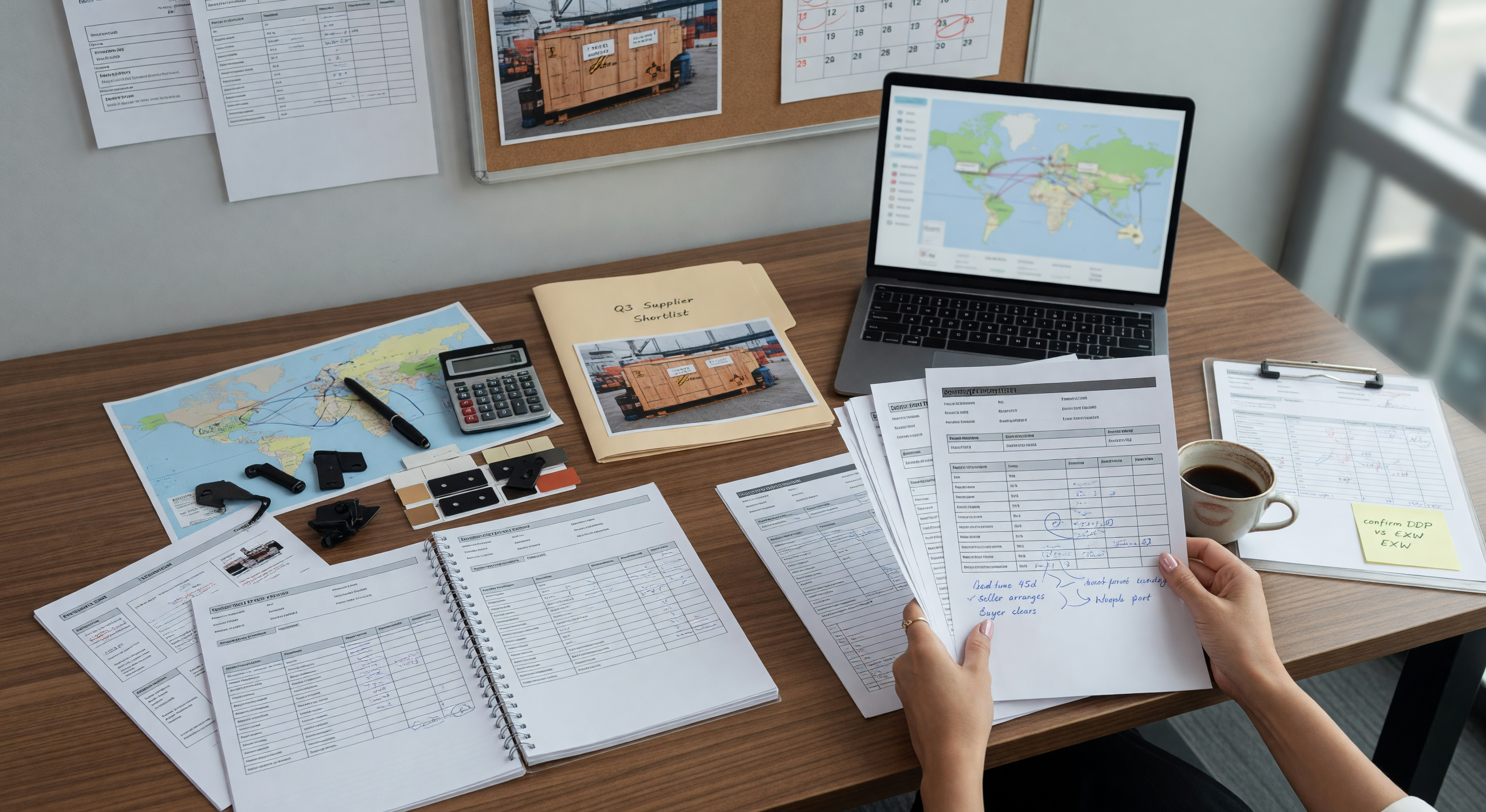
A sample order should answer a specific buying question, not just create a small version of a future shipment. Before you compare listings, write down what the sample must prove for your United States customer, store, or team. Common goals include confirming material quality, checking size consistency, testing packaging strength, photographing the product for a buyer presentation, or validating whether a seller can follow written instructions.
Start with a narrow shortlist from https://cusket.com/products, https://cusket.com/search, or category pages such as https://cusket.com/categories. Save the exact product names, variants, and seller notes you used when choosing the sample. If you later approve the product, this record helps you avoid replacing a successful sample with a similar but different item.
Choose variants that represent the real order
Sample orders often fail because the buyer chooses the easiest variant instead of the most important one. If a future order will include multiple colors, sizes, capacities, plugs, finishes, or bundles, identify which combination carries the most risk. The first sample should usually test the highest-risk configuration, not the cheapest one.
Ask whether color, logo placement, material thickness, scent, texture, weight, or included accessories change by variant. If the seller offers a range, avoid assuming that one sample proves every option. You may need one base sample plus a small swatch set, accessory set, or approval photo for the remaining variants.
Use the product page and checkout path on https://cusket.com/buy to keep the selected variant visible while you prepare instructions. If the sample is for a future commercial order, include the expected next-order quantity range in your message.
Prepare delivery and invoice details early
For a United States delivery address, confirm the recipient name, company name, street address, unit or suite, city, state, ZIP code, phone number, and email before placing the order. If the sample is going to a warehouse, lab, agency, photographer, or trade-show office, add receiving hours and any internal reference number.
Invoice details should match the party that needs the record. For many buyers this means the company legal name, billing address, contact email, and purchase order or project code. Cusket can help organize the order flow, but buyers should confirm tax, accounting, import, and recordkeeping requirements with their own advisers where those details matter.
Customs descriptions should be plain and accurate. Use a practical product description, material, quantity, and intended sample purpose when available. Avoid vague labels such as "gift" or "parts" if they do not describe the goods. Duties, taxes, classification, and admissibility can depend on the item and circumstances, so treat customs-related notes as information to review, not legal certainty.
| Item to confirm | What to write down | Why it matters |
|---|---|---|
| Sample objective | Inspection, photos, testing, demo, or fit check | Keeps the evaluation focused |
| Variant | Color, size, material, bundle, plug, finish | Prevents approving the wrong version |
| Ship-to address | Full US address, contact, phone, receiving hours | Reduces delivery exceptions |
| Invoice reference | Company name, PO, project code, billing email | Helps internal reconciliation |
| Packaging request | Retail box, inner carton, labels, protective fill | Shows whether packaging can survive handling |
| Customs description | Clear product name, material, quantity, sample purpose | Supports cleaner shipment records |
| Approval evidence | Photos, measurements, test notes, defect log | Makes the reorder decision traceable |
Request approval photos before shipment
Approval photos are useful when they show details you can actually judge. Ask for clear photos of the front, back, sides, top, bottom, label area, accessories, packaging, carton, and any custom mark. For dimensional products, request photos with a ruler or scale next to key measurements. For soft goods, ask for seams, zippers, stitching, fabric close-ups, and color under neutral light.
Do not rely only on styled images. You need practical shipment photos that show the exact sample being sent. If the sample has a known risk, such as fragile corners, printed color, tight tolerance, adhesive strength, odor, texture, or moving parts, name that risk in the request. If the seller cannot provide a requested view, note that limitation.
Test the sample against written criteria
Open the sample with a checklist in front of you. Record the arrival date, package condition, outer carton markings, inner packaging, product condition, and whether the item matches the ordered variant. Take your own photos before discarding packing materials. If there is damage, photograph the unopened carton, inner packaging, and product from several angles.
Testing criteria should match the sample objective. For fit and size, measure the dimensions that matter to your customer. For color and finish, compare under consistent lighting and note whether photos exaggerate or hide the difference. For packaging, check whether the product shifts inside the box and whether labels are readable. For functional goods, test the normal use case and any obvious stress point.
Keep defect notes factual. Instead of writing "bad quality," write "left seam loose for 18 mm," "retail box corner crushed," "blue sample darker than approved photo," or "accessory cable missing." Specific notes help the seller respond and help your team decide whether the issue is acceptable, fixable, or a reason to stop.
Decide the next order with evidence
After testing, choose one of four outcomes: approve as-is, approve with changes, request a second sample, or stop. Approve as-is only when the sample meets the objective and the seller's documentation, packaging, and communication are strong enough for the next step. Approve with changes when the item is basically right but specific corrections are required before a larger order.
Request a second sample when the first result leaves a material question unanswered. That may happen when a corrected variant needs to be checked, packaging must be rebuilt, or a defect appears fixable but important. Stop when the sample fails a non-negotiable requirement or the seller cannot document changes.
Keep the decision attached to the original product link, messages, photos, invoice details, and defect notes. If you need more sourcing options, return to search or browse related categories. For general platform guidance, use https://cusket.com/guides, and if an order issue needs help inside Cusket, contact https://cusket.com/support with the order reference and your evidence ready.