Buying Guide
How to inspect tires and wheels quotes before ordering
By Cusket Editorial · Published · Updated
A buyer-focused checklist for reviewing tire and wheel quotes, including fitment, ratings, production dates, wheel specs, photos, packaging, and warranty boundaries before ordering.
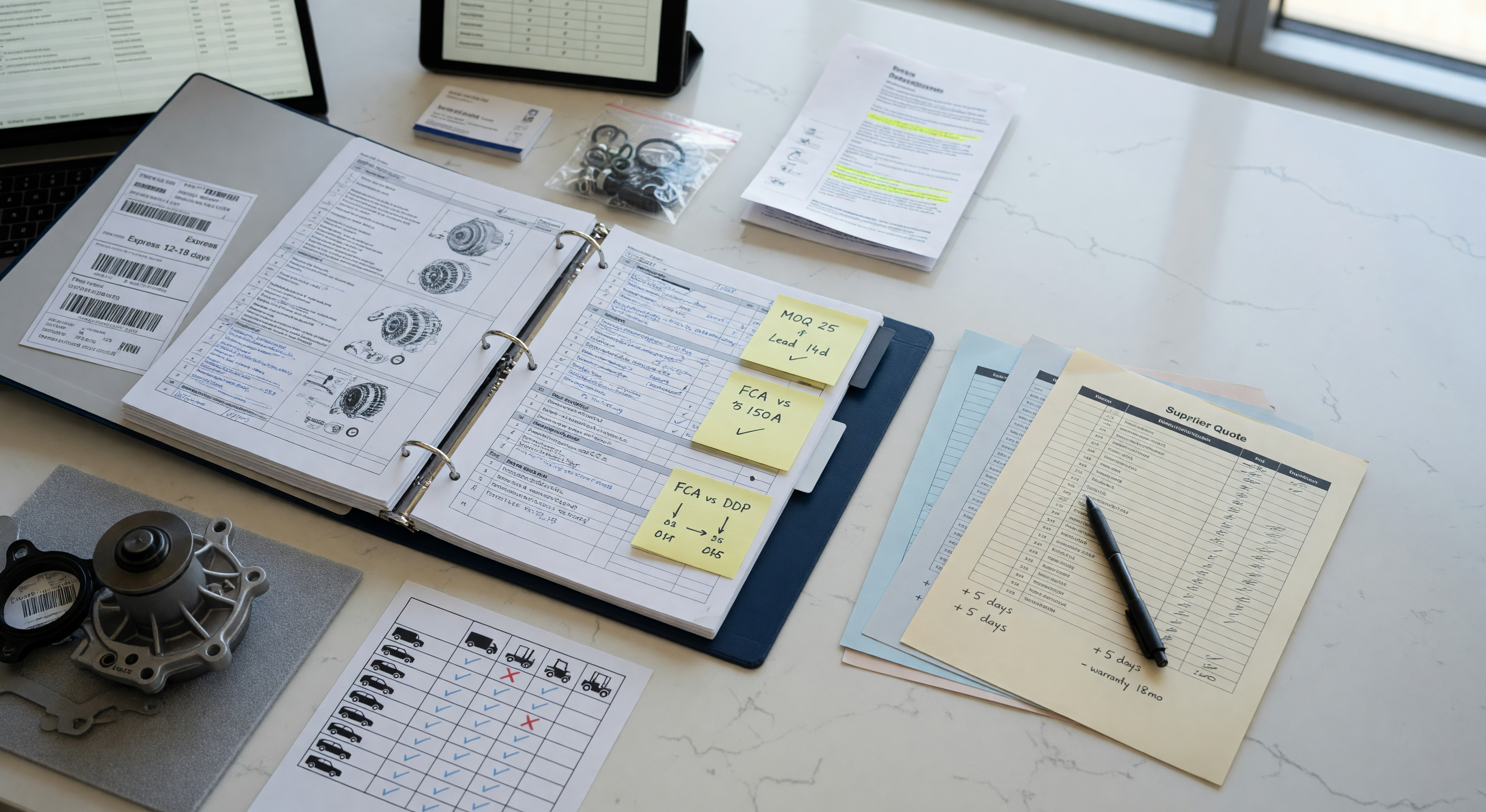
Start with fitment, not the lowest line price
Tires and wheels are quote-sensitive products because a small mismatch can make a shipment unusable. Before you compare unit prices, confirm that each quote describes the same fitment target. For tires, check the full size string, such as 225/45R18, plus the load index, speed rating, construction type, seasonal category, and whether the tire is tubeless, run-flat, reinforced, or commercial-grade. For wheels, confirm diameter, width, bolt pattern, center bore, offset, seat type, and compatible fastener style.
Use the quote as a verification document, not just a price message. If the supplier lists only a general product name, ask for the missing specification before moving ahead. You can compare similar listings on https://cusket.com/products, browse adjacent fitment categories on https://cusket.com/categories, or search matching size terms on https://cusket.com/search to understand how complete a tire or wheel description should look.
Check tire construction, tread, and production window
A tire quote should identify the tread pattern and intended use clearly enough for you to judge whether it matches the vehicle and driving environment. All-season, summer, winter, all-terrain, mud-terrain, highway, trailer, EV, and commercial patterns can look similar in a small catalog photo, but they are not interchangeable. Ask whether the quoted tire pattern is the exact pattern shown in the photos or a representative pattern from the same series.
Production date matters because tires age even when they are unused. Instead of accepting a vague promise like "new stock," ask for the production date window, usually expressed by DOT week and year or the equivalent date code used in the product market. A practical buyer request is: "Please quote stock produced within the last 12 months, or state the actual production week range before invoice."
Also confirm safety and quality markings as buyer verification. Depending on market and product type, a quote may reference DOT, ECE, GCC, ISO, CCC, BIS, or other markings. Treat those markings as evidence to inspect, not as a legal conclusion. Ask for clear sidewall and label photos so your team can review whether the markings, size, load, speed, and production code align with the quote.
Verify wheel dimensions, finish, and visible condition
Wheel quotes need more than a style name. Ask for a specification line that includes wheel diameter, rim width, PCD or bolt pattern, center bore, offset, load rating, material, finish, and whether caps, valve stems, lug nuts, or bolts are included. Offset and center bore are especially important because a wheel can share the same diameter and bolt pattern while still fitting poorly.
Finish descriptions should be precise. "Black," "machined," "polished," "chrome," "painted," "powder coated," and "diamond cut" can imply different care requirements and freight risks. Ask whether the finish is shown by current sample photos, production photos, or old catalog images. For used, refurbished, or take-off wheels, ask for a written condition grade and photos of curb rash, bends, weld repairs, corrosion, and paint defects.
If wheels are supplied as a tire-and-wheel assembly, the quote should say whether mounting, balancing, valve installation, TPMS compatibility, and protective packaging are included. If balancing is included, ask whether weights will be installed before shipment or supplied separately.
Use a quote inspection checklist before payment
Before you place the order through https://cusket.com/buy or continue a negotiation with a supplier, put each quote through the same inspection pass.
| Quote area | What to verify | What to ask for if missing |
|---|---|---|
| Tire size | Full size, load index, speed rating, construction, tube/run-flat status | Sidewall photo and complete spec sheet |
| Tread and use | Pattern name, season, vehicle/use case, exact pattern availability | Current tread photos and pattern code |
| Production date | DOT week/year or stated production window | Written date range by batch |
| Wheel fitment | Diameter, width, bolt pattern, center bore, offset, load rating | Rear stamp photo or drawing |
| Finish and condition | Finish type, included hardware, new/used/refurbished status | Close-up sample photos under normal light |
| Services | Mounting, balancing, valve, TPMS, inspection, packaging | Line-item confirmation and method |
| Shipment protection | Cartons, bead protection, wheel face guards, palletization | Packaging photos from a similar order |
| Warranty boundary | What is covered, excluded, and time-limited | Written warranty terms before invoice |
If any answer changes after the quote is revised, ask for a new dated quote instead of relying on chat history. This helps you compare the final offer against the final product specification.
Inspect photos, samples, and packaging evidence
Photos are part of the inspection trail. Request photos that prove identity and condition: sidewall markings, tread face, bead area, production code, wheel face, wheel barrel, rear pad, bolt holes, center bore, cartons, labels, and pallets. For mixed-size orders, ask the supplier to label photos by size so you do not confuse front and rear fitments. If you order samples, compare the physical item against the quote line by line and take your own photos on arrival.
Packaging deserves the same attention as product specs. Tires may need banding, wrapping, or palletization depending on quantity and route. Wheels usually need face protection, inner separators, strong cartons, and pallet stability. If the supplier says packaging is "standard," ask what that means in materials, carton strength, pallet style, and whether each wheel is individually protected.
Clarify warranty limits and next sourcing steps
Warranty language should be specific before payment. Ask what is covered for manufacturing defects, finish defects, out-of-round wheels, balancing issues, bead damage, shipping damage, and incorrect fitment. Also ask what is excluded after mounting, installation, off-road use, overloading, racing, improper storage, or cosmetic handling. These questions do not replace your own professional review, local rules, or installer judgment, but they help you understand the commercial boundary of the quote.
Keep the final decision anchored in evidence. A strong tire or wheel quote should match the requested fitment, show current product proof, identify production timing, explain included services, describe packaging, and set realistic warranty boundaries. If you need a broader sourcing path, review related buying guidance on https://cusket.com/guides and contact https://cusket.com/support if you need help using Cusket's buyer workflow.