Buying Guide
Stationery and Notebooks RFQ Checklist for Business Buyers
By Cusket Editorial · Published · Updated
A practical RFQ checklist for buying stationery and notebooks in bulk, from paper specifications and customization details to samples, packing, compliance, and reorder planning.
Start with the buying use case, not only the item name
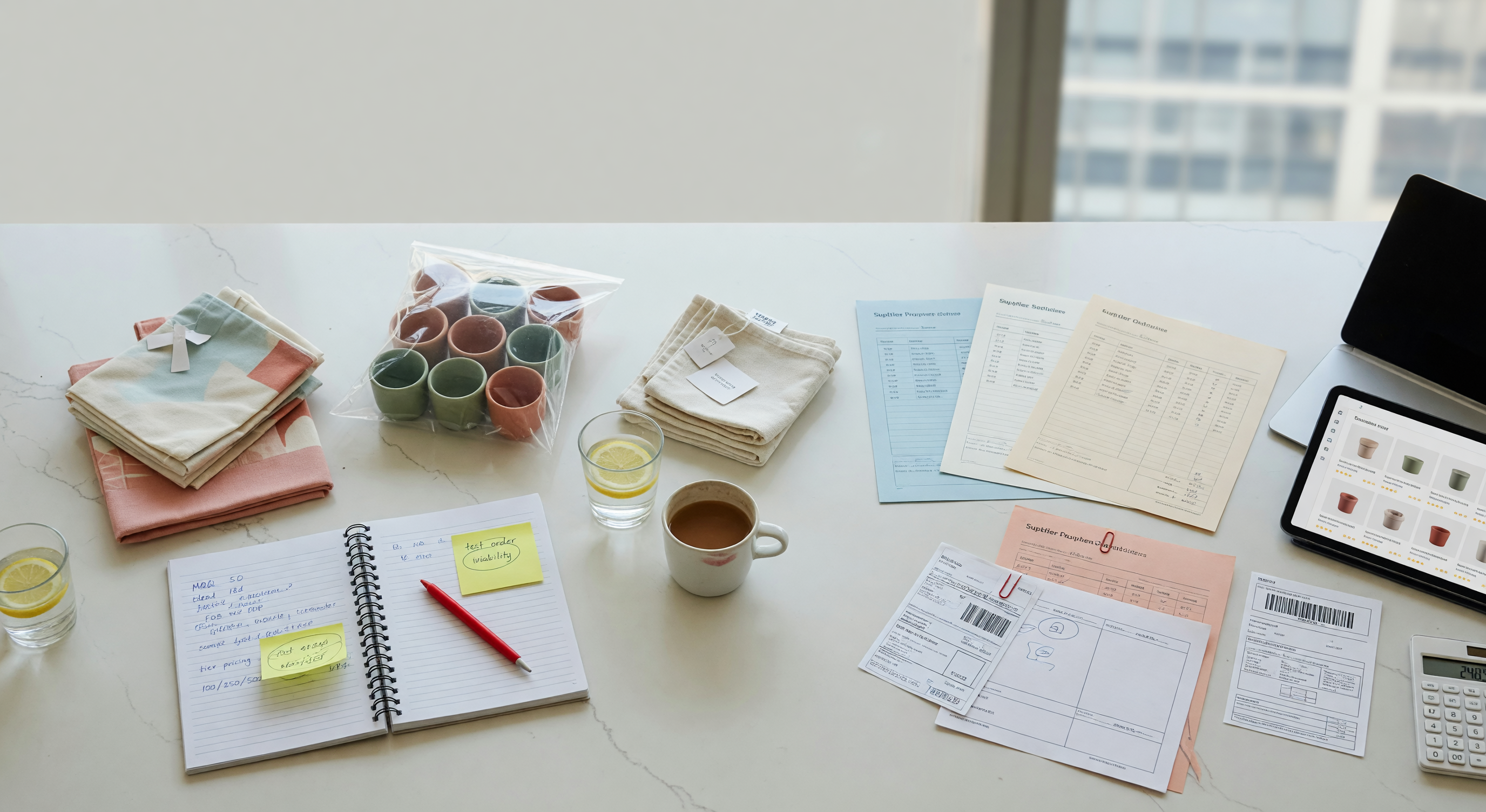
A strong stationery RFQ begins by explaining how the notebooks, pads, pens, folders, or desk sets will be used. A buyer ordering onboarding notebooks for a software team has different priorities from a school purchasing semester supplies or a hotel preparing branded guest-room stationery. Describe the end user, expected handling, brand requirements, and any deadline that is tied to an event, academic term, store launch, or office move.
Use Cusket's stationery category to shortlist relevant product types, then compare adjacent procurement paths such as office supplies and school supplies when the order crosses categories. This helps suppliers understand whether you need a single notebook SKU, a bundled kit, or a repeatable buying program.
Define notebook and paper specifications clearly
Stationery suppliers can quote faster when the physical specification is precise. For notebooks, include size, orientation, page count, binding, cover material, inner paper weight, ruling style, page color, and corner style. For loose paper, memo pads, or sticky notes, include sheet count per unit, adhesive requirements, backing board thickness, and whether the product must work with fountain pens, gel pens, printers, or archival storage.
Avoid vague phrases such as premium paper or standard size unless you also provide measurable details. If you are unsure, ask suppliers to propose two options: a cost-efficient specification and a higher-grade specification. That lets procurement compare price differences without losing control of quality.
| RFQ field | What to specify | Why it matters |
|---|---|---|
| Size and format | A5, B5, letter, legal pad, pocket, portrait, landscape | Controls paper yield, freight volume, and user fit |
| Paper | GSM, color, opacity, recycled content, bleed resistance | Affects writing feel, durability, and brand perception |
| Binding | Spiral, wire-o, stitched, glued, casebound, staple | Changes lay-flat behavior and production cost |
| Cover | Kraft, PU, fabric, hard cover, soft cover, laminated card | Drives durability and customization options |
| Pages | Count, ruled, dotted, grid, blank, numbered, perforated | Prevents functional mismatches after delivery |
Include branding and customization requirements
If the order needs logos, campaign artwork, employee names, department colors, or packaging inserts, include artwork requirements early. State whether you need custom printing, foil stamping, embossing, debossing, screen printing, UV print, belly bands, inserts, or custom boxes. Include the number of print colors, artwork placement, acceptable color tolerance, and whether the supplier must provide a digital proof before sampling.
For brand-sensitive orders, ask suppliers to confirm file formats, color system, minimum line width, bleed area, and proof approval steps. If you already have brand guidelines, summarize the non-negotiable details in the RFQ and attach full guidelines through the ordering conversation. For multi-location businesses, request carton labels or packing lists by department, branch, or recipient group.
Ask for samples before approving bulk production
Samples reduce the risk of receiving notebooks that look acceptable online but fail in daily use. Ask for photos, video, stock samples, and pre-production samples where practical. For a repeat order, request that the supplier keep an approved control sample and confirm whether future batches will match it.
Your RFQ should state who pays for samples, whether sample fees are refundable after bulk order placement, and how long sample production takes. When reviewing samples, do not check only the cover. Open the notebook flat, write on both sides of a page, test ink bleed, check page alignment, inspect binding strength, and compare the printed logo against the approved proof. If a team will use the product daily, send samples to real users before locking the order.
Compare pricing by landed cost and reorder flexibility
Unit price is only one part of stationery procurement. A low notebook price can become expensive if cartons are oversized, packaging is weak, or the minimum order quantity forces excess inventory. Ask suppliers to quote by quantity tier, including setup fees, plate fees, artwork charges, sample charges, export packing, and estimated freight dimensions.
When searching Cusket products or using Cusket search, compare suppliers on the full buying model: MOQ, lead time, customization capability, reorder terms, and communication clarity. For recurring office supply programs, ask whether the supplier can hold artwork, repeat the same paper stock, reserve production capacity, or split shipments across months. A slightly higher first order may be worthwhile if it creates a dependable reorder path.
Confirm compliance, packaging, and delivery details
Business buyers should treat stationery as a physical supply-chain item, not a casual desk accessory. Ask about paper sourcing, recycled content claims, FSC or similar certifications when relevant, ink safety, restricted substances, and any documentation required by your organization. For school or child-facing products, ask whether materials, coatings, and accessories meet applicable safety expectations for the destination market.
Packaging should be specific. State inner pack quantity, carton quantity, carton weight limits, moisture protection, barcode needs, retail labeling, and whether mixed SKUs can be packed in one carton. If the order is for a launch, event, or school term, build in time for sample review, production, quality inspection, customs, and last-mile receiving. When the timeline is tight, ask suppliers to identify the critical approval date rather than simply promising a delivery date.
Send a complete RFQ checklist
Before sending the RFQ, make sure the supplier can quote without guessing. A concise but complete request usually receives better pricing and fewer follow-up delays.
- Product type, intended use, and target user group
- Quantity, quantity tiers, and expected reorder frequency
- Notebook size, page count, ruling style, paper GSM, cover material, and binding
- Custom printing, logo placement, artwork file format, and proof requirements
- Sample type requested, sample deadline, and approval process
- Packaging, carton labeling, barcode, and destination requirements
- Compliance documents or sustainability claims needed
- Target delivery date, shipping terms, and receiving location
- Required quote currency, payment expectations, and quote validity period
After you collect responses, compare them side by side instead of choosing only the lowest unit price. Keep a record of the approved specification, sample photos, supplier notes, and reorder terms. For additional procurement guidance, browse Cusket guides, and contact Cusket support if you need help navigating supplier conversations or order details.